


Suffering Draws Us to God

Grief has many faces. It seizes every side of a person’s life: material, social, solitary, family. As a mirror reflects a man’s image, so every grief leaves its imprint on people’s faces. Some under trial keep a bitter smile, others a hard gaze, others a gloomy face expressing indifferent submission, others still a pain that, it seems, neither people nor time can or will wipe away.
Dear friend, if you are passing through trials, this word is for you!
I do not know the circumstances of your life, nor the nature of your suffering, nor your personal convictions. I do not know whether you are a believer or not. If you have faith, do you find in it any help when grief comes crashing down on you? I know only one thing: you are suffering, and that is enough for me to feel close to you. I do not force myself upon you. Do with my words whatever you wish.
Like a milestone, they will simply point out to you a road on which the grief that exists takes on a different look. On this road grief will not frighten you, will not bring disappointment or bitterness. On it you will not feel alone or in despair.
Dear friend, you suffer in solitude, and it seems to you that no one has ever borne such suffering. Your happiness is shattered, your plans are ruined. But do you know that all that you call happiness is in reality only an illusion? You considered yourself master of life, the fulfiller of your own desires. Thanks to your wealth and your work you were not a pauper, but suddenly material difficulties overtook you; illness tore you from your work and made you dependent on others, and this plunged you into despair. You counted on having happiness on earth: in your family you were loved, cared for, and every wish of yours was anticipated. Today either the grave has carried away with it a heart that loved you, or a drama has ruthlessly destroyed your family hearth…
You counted on continuing your life in your children. For them you amassed wealth and made plans. You wanted to give them what your parents could not obtain for you… And now it has happened that your beloved son has gone to the land of silence from which no one returns, or, acting ungratefully, has become a stranger to you and perhaps even disgraced you.

Powerlessness! Disappointment! You are indignant, you rebel against fate, against God. But this is a delusion, because indignation against God will change nothing.
Listen: the trial through which you are passing is not the chief and true cause of your sorrow. Man is unhappy by nature. The thirst for happiness, the constant dissatisfaction, is the best proof of it. Man would like to have the whole universe, his heart thirsts for it, but in the end nothing belongs to him.
Man brought nothing into this world, and will carry nothing out; everyone knows this perfectly well. Yet man was not created for suffering; he feels this. His heart desires joy and fullness of happiness, for the sake of which people recklessly plunge into the mire of momentary pleasures.
Man must acknowledge one thing: his happiness depends not on good or bad circumstances of life, but first of all on the state of his soul.
A rich man, possessing untold wealth, may be deeply unhappy, while a poor man in complete poverty sings! It happens that a healthy man does not cease to complain, while a sick man is cheerful and comforts the healthy. Many pampered women, bathing in luxury and entertainment, die of longing and boredom, while a poor widow, under an unbearable load of labor and care for her family, still finds time to help her neighbors and does so with a face shining with joy.
Happiness is not in circumstances and not in people. Happiness is in God, and it depends on our attitude toward Him. Whether people want it or not, God exists!
People may reckon with Him or not, but He is the true source of happiness. The whole trouble is that man lives far from God, and therefore he has no peace in his soul: when he is rich, he wants to have still more; when he is surrounded by love, he is afraid of losing those he loves; when he is healthy, he does not value his health. And suddenly, in such a state, grief falls upon him. Since he did not experience true joy in abundance, can he be content when deprivation overtakes him?
Only God’s school can teach him to be content. He knew only earthly love; will he be able to understand divine love, which is able to comfort the orphan and to take the place of mother, father, wife or husband? That is why, when death takes from a man what is dearest in the world, he is left stricken, broken and utterly alone. Only God’s school can teach a man to love God even for His temporary gifts.
A believing man does not feel alone in grief, because he knows that with God even the dead are alive! But since the unbelieving man has never glorified God, will he be able to give Him thanks in grief or sickness? Only fellowship with God would teach him to submit to the holy will and to seek in Jesus the power that heals spiritual wounds.
Man has lived his life without God. He neglected the fact that in this world there is a Lord and Master. He did not prepare for His visit. And since his Lord and Sovereign did not plainly force His presence upon him, did not assert His rights over him, and gave him a certain freedom, man imagined that he was his own master and could possess absolutely everything on earth.
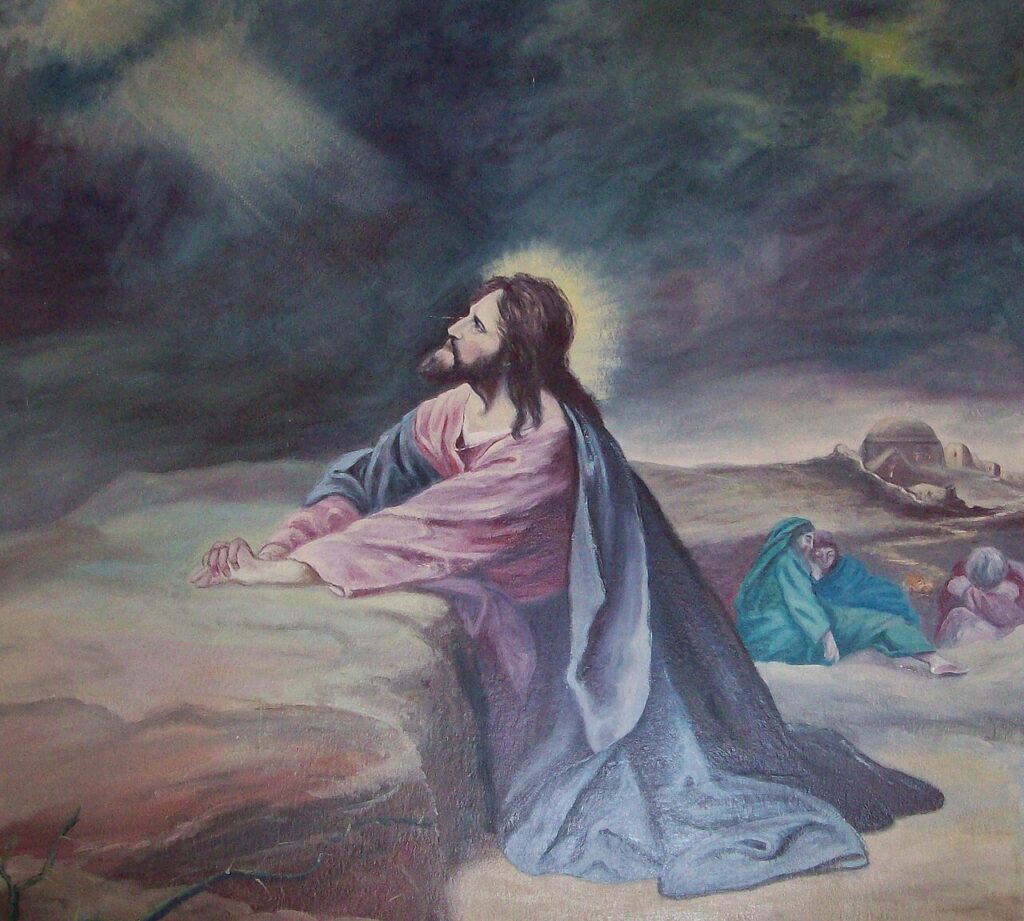
Now, when the Sovereign of the worlds takes from this man, insensible to the many benefits of God, what belongs to Him, the man protests: it is unjust!
He made use of life without God, and now he must suffer without God. Can it really be so? Does God really want this? No, no, and no! God wants us to understand that even the greatest grief is not the cause of our suffering. The cause is that we have forsaken God. The absence of God in our life is what makes grief tragic. The absence of the One who is above grief, who rules over it, transforms it, and who instructs us as a Father: this is the true cause of our despair.
Sorrow is only an examination which we must pass through. But without God man is not ready for sorrow. He does not know the God of love, and it seems to him that He speaks to him in an unfamiliar language. The examination confuses man. The pupil would like to ask questions himself instead of answering God. Man wants to be the judge instead of the defendant.
The sorrow sent to us always has the purpose of directing our thoughts and our heart toward spiritual reality. God wants to make us understand that He alone abides for ever and that only spiritual reality is eternal.
But for this God must reveal Himself to us and we must come to know Him. Man does not believe in God not because he is clever enough, but because he does not want to think about God, counting spiritual interests as nothing. And if he admits the thought of God’s existence, he often, alas, lives as if God did not exist at all.
Man does not let God into his everyday life. He suffers alone, struggles alone, loves alone. He lives as if God had not come to earth, had not shared in our joys and sufferings. To him God is the Great Stranger who has withdrawn into the depths of heaven.
Man lives weighed down by his sorrows, cares and sins, as though God incarnate in Jesus had not taken upon Himself all our physical, moral and spiritual burden, as though the unchanging words of Holy Scripture had not been fulfilled: “Surely he hath borne our griefs, and carried our sorrows: yet we did esteem him stricken, smitten of God, and afflicted. But he was wounded for our transgressions, he was bruised for our iniquities: the chastisement of our peace was upon him; and with his stripes we are healed” (Book of Isaiah, chapter 53, verses 4–5).
Dear suffering friend, do you know the Savior? You need not only the historical Jesus, but the living Christ, who died for your sins and rose again for your justification; a Christ who today transforms all your sorrows, surrounding you with His mercy, passing with you through the darkest tunnels.
You need Christ, who is your wealth, your wisdom. Christ alone is able, by His wonderful presence, to fill the emptiness of your life.

Why do you not go to Jesus? Not to a religion of rites and dogmas, but to a Person worthy of worship, to the One who gives life, of whom Holy Scripture speaks.
Do you not hear at this moment the call addressed to you: “Come unto me, all ye that labour and are heavy laden, and I will give you rest. Take my yoke upon you, and learn of me; for I am meek and lowly in heart: and ye shall find rest unto your souls. For my yoke is easy, and my burden is light” (Gospel of Matthew, chapter 11, verses 28–30).
Come to Him, and you will see that God fulfils all His promises. In Him you will find a Father who knows what your body and soul need. And then your grief will take on quite a different form. In your grief you will see a messenger of heaven leading you to God, the source of eternal happiness.
Suffering has driven away from God only formalists, hypocrites, all those who in their lives do not acknowledge the authority of the Lord, His right to bring up, teach and correct His creation, who desires through Jesus Christ to make His children of those who repent of their sins.
When sufferings are received as mercy, they will not be slow to bring the true fruit of righteousness. And then the triumphant words of the Apostle Paul will become yours: “If God be for us, who can be against us? … Who shall separate us from the love of Christ? shall tribulation, or distress, or persecution, or famine, or nakedness, or peril, or sword? … Nay, in all these things we are more than conquerors through him that loved us. For I am persuaded, that neither death, nor life, nor angels, nor principalities, nor powers, nor things present, nor things to come, nor height, nor depth, nor any other creature, shall be able to separate us from the love of God, which is in Christ Jesus our Lord” (Epistle to the Romans, chapter 8, verses 31, 35, 37–39).